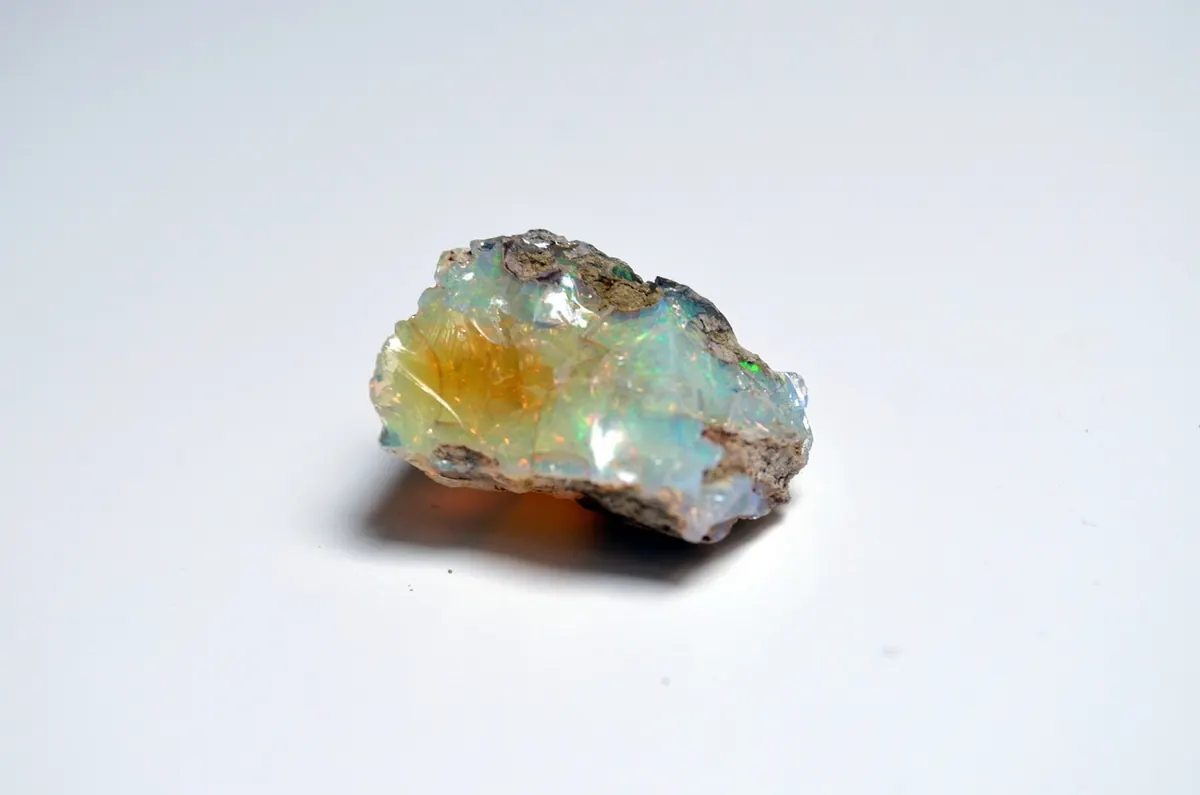
An Ethiopian opal and an Australian opal can look almost identical on a screen and behave completely differently once they're set in jewellery. Both are opal: silica with water locked inside, flashing colour as light bends through microscopic spheres. Where they part ways is in origin, toughness, how they react to moisture and what you'll pay. Australian opal has been mined commercially for well over a century and remains the benchmark for stability and value. Ethiopian opal came to the market in real volume much more recently, and it offers striking brightness at prices that make a first purchase possible. Knowing which type you're looking at helps you buy something you'll still be happy with in ten years.
Where Each Stone Comes From
Australia's opal fields are spread across thousands of kilometres, and each has its own character. Lightning Ridge in New South Wales is famous for black opal, where a dark body tone makes the colour appear to burn from inside the stone. Coober Pedy in South Australia produces the white and crystal opal most people picture first. Andamooka, Mintabie and the Queensland boulder fields fill in the rest, with boulder opal cut so the colour sits in a natural ironstone backing.
Ethiopian opal comes mainly from the Wollo province in the north, often spelled Welo, with older deposits further south in Shewa. It forms in volcanic rock rather than the sedimentary settings of Australia, usually as nodules and seams in rhyolite. The practical consequence is that much Ethiopian material is hydrophane: it absorbs water. That single property shapes almost everything about how you should store, wear and clean it.
Appearance: Body Tone, Pattern and Play of Colour
Australian opal
Australian stones are usually sold by type, and the type tells you a lot. Black opal has a dark, sometimes near-black background, which creates the strongest contrast and the most dramatic colour. Crystal opal is transparent or semi-transparent, so the colour appears to float inside a clear body. White opal sits on a milky base, often with a softer, more pastel play of colour. Boulder opal shows colour within brown ironstone, frequently cut as freeforms that follow the natural shape of the seam.
These stones generally look their best in reflected light. A good black opal reads clearly across a room, which is one reason it holds its value so well.
Ethiopian opal
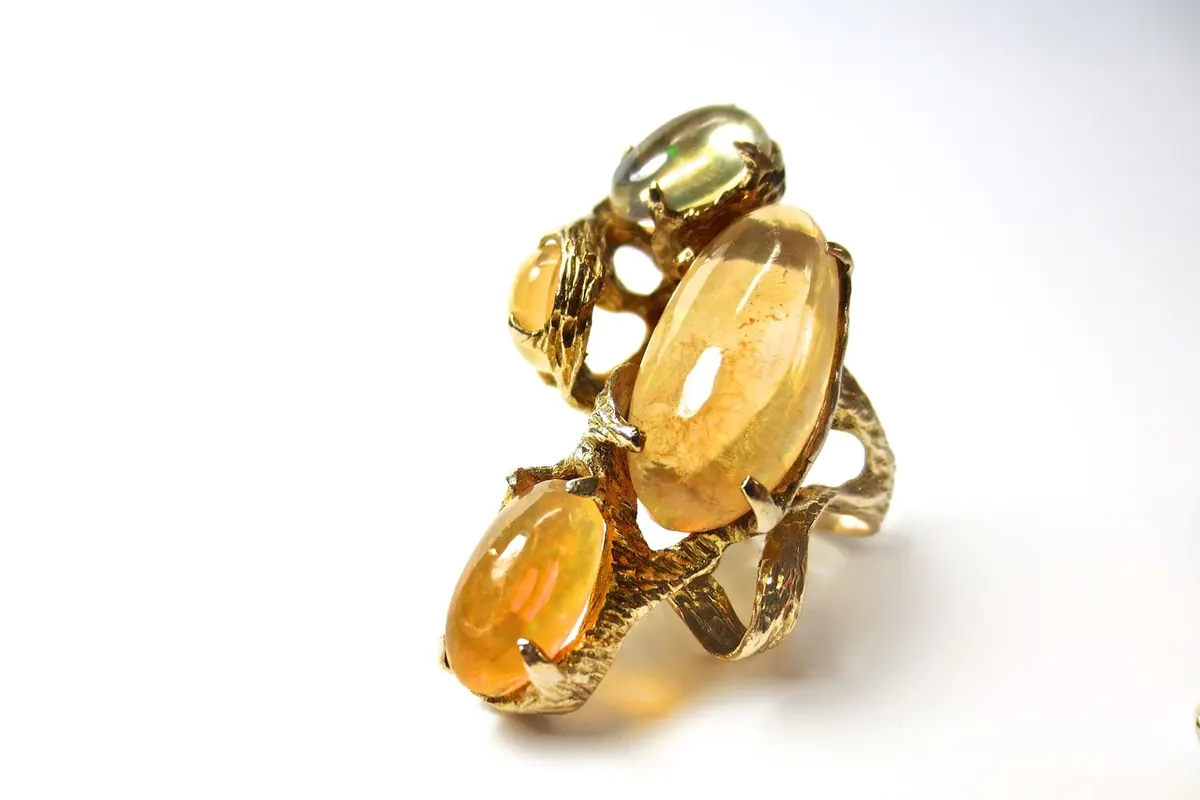
Ethiopian opal often has a clear, honey or near-colourless body, with bright broad flashes and rolling patterns. Some stones show harlequin or honeycomb-like patterns that compare well with Australian material of a similar size. The catch is contra luz behaviour: many Ethiopian opals show more colour in transmitted or backlight than in flat indoor lighting, so a stone that dazzles at a window can look quieter on a cloudy afternoon indoors. Dark body tones are rare, which is why some stones are smoke treated to deepen the background colour. Treated stones should always be disclosed, and they are worth less than untreated ones.
Durability: The Difference That Matters Most
Both types are opal, so both are relatively soft. Opal sits around 5.5 to 6.5 on the Mohs scale, similar to glass, which means it scratches and chips more easily than sapphire or diamond. Neither is a good choice for a stone you'll knock against a doorframe every day without a protective setting.
The real difference is moisture. Australian opal is generally not porous, so a splash of water or a wipe with a damp cloth is harmless. Many Ethiopian opals are porous: they take in water, oils and anything else they touch. A hydrophane stone that absorbs water often goes cloudy or translucent and then clears as it dries, usually returning to normal if it dries slowly. Absorbed oils and dyes are a bigger problem, because they can leave colour behind in the stone itself.
Rapid changes in moisture can also cause crazing, the fine internal cracks that make a stone look milky or brittle. Some Ethiopian material is more prone to this than others. If you want a ring you can wear daily, an Australian solid or boulder opal is generally the safer bet. Ethiopian opal suits pendants, earrings and pieces worn occasionally, where it stays away from water and hand cream.
Care Advice by Type
- Both types: keep them away from ultrasonic and steam cleaners, household cleaners, bleach and chlorine. These attack the stone or, in the case of doublets and triplets, the glue holding them together.
- Both types: store opals separately in a soft pouch or lined box. They scratch each other and softer stones in a shared jewellery tray.
- Both types: remove rings before gardening, cleaning, gym sessions or washing up.
- Ethiopian opal: never soak it. Take it off before showering, swimming or washing your hands, and keep it away from perfume, hairspray, sunscreen, hand cream and cooking oil.
- Ethiopian opal: if it does absorb water and turn cloudy, let it dry slowly at room temperature, out of direct sun. Don't use a hairdryer or a radiator, and don't handle it while it dries.
- Doublets and triplets: never immerse them, whichever country the opal came from. The bond can fail and the layers separate.
- Australian solid opal: a wipe with a soft, barely damp cloth is usually enough. Dry it well afterwards.
For a valuable piece, ask a qualified gemmologist or jeweller before cleaning it yourself. Cleaning advice for one stone can damage another.
What You'll Pay
Australian black opal sits at the top of the market. A fine black opal with a dark body tone, strong brightness and a defined pattern can cost many times what an Ethiopian stone of the same size would, and prices rise sharply with size. Crystal and white Australian opal are more moderate, and boulder opal often gives you excellent colour for mid-range money because the ironstone backing keeps cutting costs down.
Ethiopian opal is generally the most affordable route to bright play of colour. Small, clean Welo stones are widely available and inexpensive; large stones with tight patterns and good brightness command considerably more. Expect to pay noticeably less than for an Australian opal of similar size and flash, and remember that treated stones, including smoke-treated Ethiopian material and sugar-and-acid treated Andamooka matrix, should be cheaper again.
Prices move with supply and fashion, so treat any figure you see online as a starting point rather than a rule. If you're spending a significant amount, buy from a seller with a clear returns policy and consider an independent valuation for insurance.
Choosing Between the Two
Start with how the piece will be worn. A daily-wear ring, especially one with an exposed edge, points towards Australian solid or boulder opal in a bezel setting that protects the rim. A pendant, brooch or pair of earrings opens up Ethiopian opal, where the lower price buys you a bigger, brighter stone.
Then look at the stone in more than one light. View it in daylight, indoors and backlit. Australian opal should hold its colour in all three; Ethiopian opal often looks its most spectacular with light passing through it, which is worth knowing before you commit.
Ask two questions before you buy. Where was the opal mined, and has it been treated? A reputable dealer will answer both without hesitation and put the origin in writing on the receipt. For Australian material, it's also worth asking whether the stone is solid or a doublet or triplet, since assembled stones are worth far less than solid ones.
Finally, compare like with like. Body tone, brightness, pattern, size and cut quality matter more than the country on the label. A well-cut Ethiopian opal with a tight, vivid pattern is a better buy than a dull, poorly shaped Australian stone, and a modest Australian crystal opal can outshine a large, milky example from anywhere. Buy the stone in front of you, not the name attached to it.
Photo: Varga / Pixabay