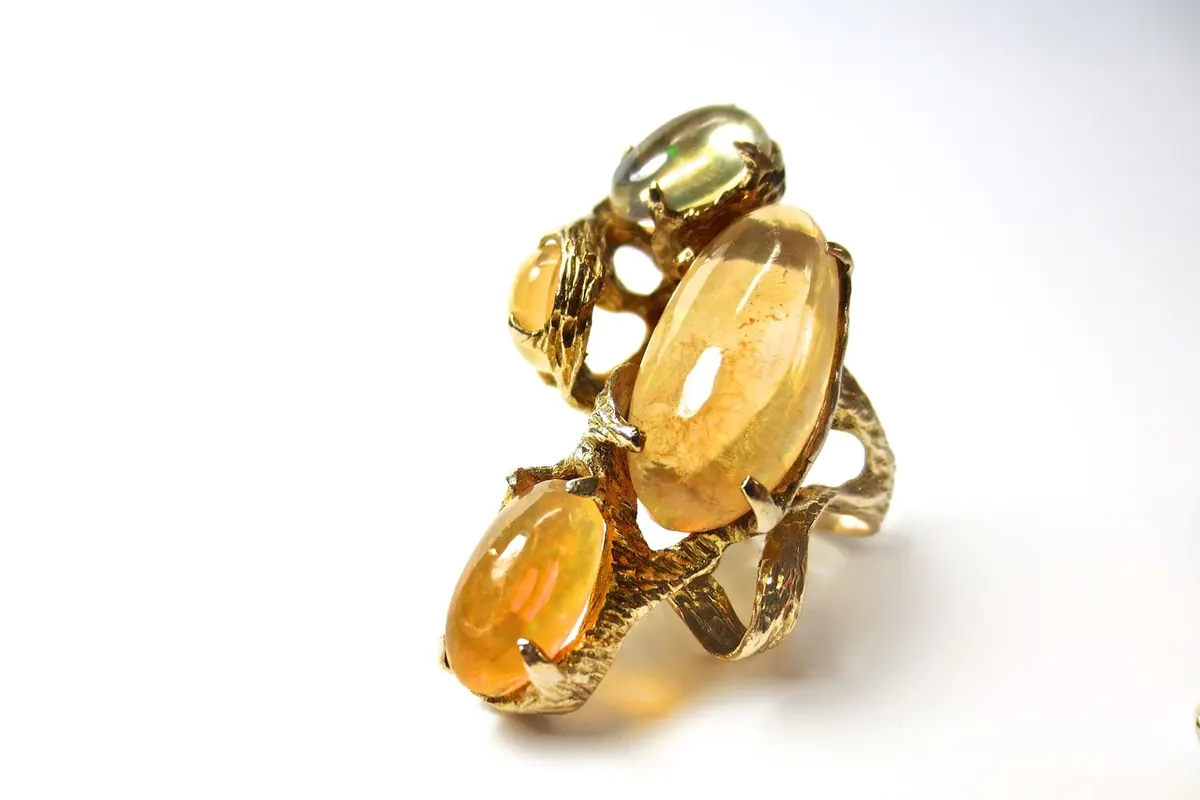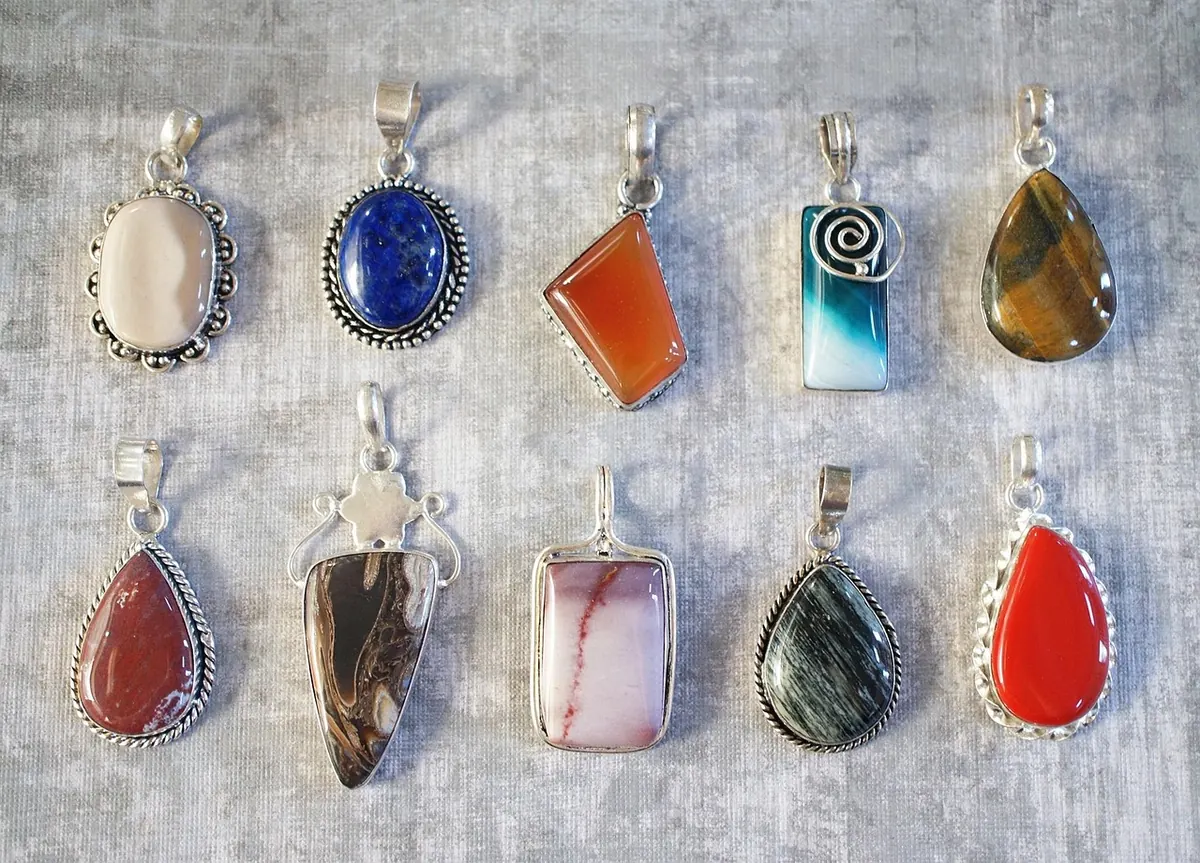
A doublet opal is one of the most useful stones in the opal trade, and one of the least understood by new buyers. It looks like a solid opal, wears much like one, and often carries colour that would cost several times more if it arrived as a single natural piece. Learning how it is put together takes a few minutes, and it will change the way you read an opal listing for good.
What a doublet opal actually is
A doublet is a thin slice of natural precious opal bonded to a supportive backing. That is the entire idea. The opal itself is genuine — mined, cut and polished like any other — but it is too thin to survive on its own. As a standalone stone, that slice would crack in a setting or chip the first time it caught a doorframe.
The backing does two jobs at once. It gives the slice physical strength, and it almost always supplies a dark background. Colour play in opal behaves a little like light bouncing off the surface of water, so a dark base beneath a thin colour layer makes the flashes read deeper and brighter. The same pale slice sitting on a black backing can look dramatically richer than it would alone.
Common backing materials
Ironstone is the traditional choice, and it is what most Australian doublets use. Basalt, obsidian and black potch — opal with no play of colour — also appear. Occasionally you will find resin, glass or a dyed material doing the job. Each has a slightly different weight and feel, but the effect on the colour is the same: contrast.
How a doublet is made
The process is simple in principle and fussy in practice. Roughly, it goes like this:
- The opal is sliced thin, often only a fraction of a millimetre to a couple of millimetres thick. Cutters call this the face or the skin.
- Its underside is ground flat and cleaned so the adhesive will grip properly.
- The backing is cut to a matching shape and flattened in the same way.
- A resin or epoxy is applied thinly and evenly, and the two pieces are pressed together.
- Once the bond has cured, the assembled stone is ground to its final outline and polished across the face and around the edge.
Because the join sits at the edge of the stone, it is usually visible if you look for it — a straight line where the shimmering layer stops and the darker backing begins. That line is not a fault. It is simply the construction showing.
Doublet, solid and triplet: the differences that matter
- Solid opal. Natural opal all the way through, with no adhesive and no backing. Generally the most durable and the most valuable, and the only kind that can safely be recut or reshaped later.
- Doublet opal. Two layers: a natural opal face bonded to a backing. All the colour comes from real opal; the backing is there for strength and contrast.
- Triplet opal. Three layers: a natural opal slice sandwiched between a backing and a clear dome, usually quartz or glass. Cheaper again, but the cap slightly mutes the colour and can scratch over time.
In a solid stone, the colour belongs to the whole body of the opal. In a doublet, it belongs to a layer sitting on top of the backing. In a triplet, it is sealed behind a dome. That single distinction explains most of the price gap between the three.
Why doublets exist, and who they suit
Good colour in opal often runs in thin seams. When a cutter finds a beautiful band of colour that is simply too skinny to stand alone, throwing it away would be wasteful and a little tragic. Bonding it to a backing rescues the material and turns it into something wearable.
For buyers, that means vivid, large-looking stones at a modest price. A bright doublet pendant can deliver the look of black opal for a fraction of the cost of an equivalent solid stone. What it will not do is hold value the way a solid opal does, and it should never be sold as solid. Reputable dealers label doublets clearly — if you have to ask twice, treat that as information in itself.
What to check before you buy
Take a jeweller's loupe, or the magnifier on your phone, and work through this list:
- Find the join. Tilt the stone and look at the side. A clean, tight, straight line is normal.
- Check for gaps, lifting or a milky haze near the glue line. Any of these suggest the bond is already failing.
- Judge the thickness of the colour layer. Very thin faces are more delicate and generally worth less.
- Ask outright: is this solid, a doublet or a triplet? A confident, immediate answer is a good sign.
- Compare prices honestly. If a large, brilliantly coloured stone costs a small fraction of comparable solid opals, there is a reason.
- Look at the pattern. Real opal colour shifts and moves as you turn the stone. A flat, sheet-like effect that barely changes is worth questioning.
- Think about the setting. A bezel or protective edge guards the join. A doublet set with exposed edges is more vulnerable.
For any significant purchase, ask for the description in writing, and consider having a piece independently assessed by a qualified gemmologist or valuer before you commit.
Caring for a doublet opal
Treat it as you would any opal, with a little extra caution around water and heat. Take rings off before swimming, showering, washing up or using a hot tub — prolonged soaking can work its way into the join. Skip the ultrasonic and steam cleaners entirely; the vibration and heat are exactly what lift a bonded layer. Keep perfume, hairspray and cleaning products away from the stone, and store it in a soft pouch rather than loose in a jewellery box where harder stones can scratch the face.
To clean it, wipe gently with a soft, barely damp cloth and dry it straight away. If you ever see the colour layer beginning to lift at one edge, stop wearing the piece and take it to a jeweller — small lifts are sometimes repairable, larger ones rarely are.
Buying a doublet with confidence
Choose a doublet when you want the look of opal at an accessible price, when you are buying a bold statement pendant, or when you simply love a particular stone and accept what it is. Choose a solid opal when you want something to pass on, something that can be reset and reshaped, or something that will hold value.
Neither choice is wrong. The only mistake is not knowing which one you are holding — so look at the edge, ask the question, and buy from someone who answers it plainly.
Photo: starbright / Pixabay