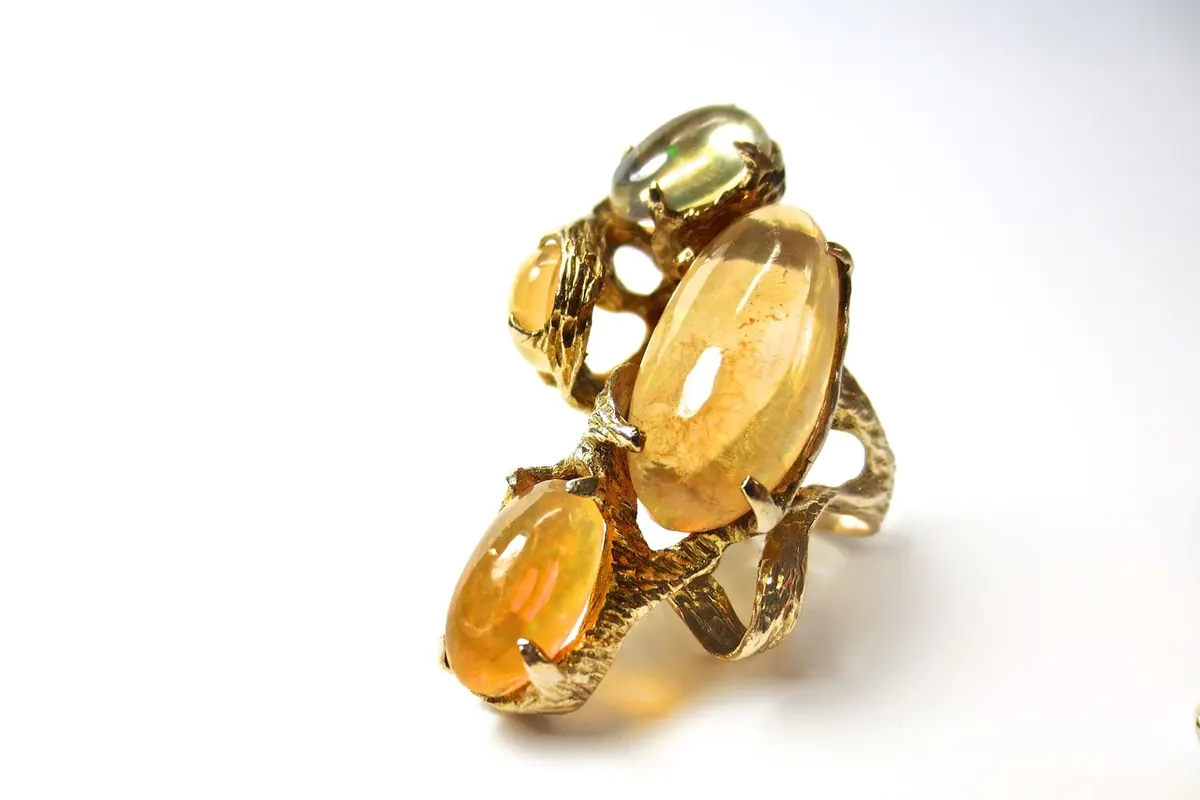
An opal bought under a jewellery-shop spotlight can look like a different stone in your kitchen. That is not dishonesty — warm, directional light flatters play-of-colour the way it flatters everything else — but it does mean the buying conversation matters more than it does with a diamond or a plain gold band. Opals vary enormously in quality, they are treated more often than most buyers realise, and they are softer than the gems most of us are used to wearing. A handful of questions, asked before you hand over a card, will tell you whether the seller knows their stock and whether the stone is right for you.
See it in daylight before you decide
Ask to take the piece to a window, or better still, step outside with it. Natural daylight — overcast rather than blazing sun — shows the true body tone and how the colour shifts as you tilt the stone. Direct sunshine can wash the colour out, and a phone torch is worse still.
Look at the play-of-colour from several angles, not just one. A good opal should flash across a wide range of movement rather than performing from a single position. Then hold it up to a lamp and look through it: internal cracks, known as crazing, often look like fine spider lines, and they rarely improve with time. If the seller has been keeping the stone in water or oil, ask why — sometimes it is routine care for certain material, sometimes it is a temporary way of masking a flaw.
Some sellers talk about body tone and brightness scales. Those can be genuinely useful, but only if the person using them can explain plainly what they mean for the stone in your hand.
Is it solid, a doublet or a triplet?
“Is it real?” is the wrong question. Opal can be entirely genuine and still not be solid. Ask instead: is this a solid opal?
- Solid — a single piece of natural opal, cut and polished.
- Doublet — a thin slice of opal glued to a dark backing, usually ironstone or potch.
- Triplet — the same idea, with a clear quartz or glass cap bonded on top for protection.
Doublets and triplets are legitimate, affordable ways to own colourful opal. They simply need to be sold as what they are, and priced accordingly. Never let a doublet be presented as a solid stone.
Then ask about treatment
Treatment is where conversations get vague, so push gently. Some opal is treated with sugar and acid to darken the background, some is smoked, and some is stabilised with resin. Ethiopian hydrophane opal can absorb water and oils, which may change how it looks for a while. Ask what, specifically, has been done to the stone, then ask for the answer on the receipt. A seller who cannot or will not put it in writing is telling you something useful.
What does the paperwork actually say?
Opal has no single universal grading system of the kind diamonds enjoy, so a certificate confirms less than many buyers assume. A laboratory report will typically verify what the material is, whether it has been treated, and sometimes where it came from. It will not tell you that the stone is beautiful, or that it suits you.
What you should insist on is a written description: solid, doublet or triplet; any treatment; the metal and its purity; and the total carat weight if there is more than one stone. For a significant purchase, ask about a valuation for insurance purposes — that is a separate document from your receipt, and your insurer may want it.
Sizing, setting and everyday wear
Ring resizing is not always possible. A claw-set solitaire can often be adjusted; a wide band set with opal inlay may not be, and an eternity ring set all the way round usually cannot be resized at all without disturbing the stones. Ask how many sizes the piece can be adjusted by, whether resizing is included, and how long it takes.
Ask about the setting too. A bezel surrounds and protects the edges of the stone, which matters because opal is relatively soft — roughly 5.5 to 6.5 on the Mohs scale, softer than quartz. Claw settings show more of the stone but leave the edges more exposed. If you plan to wear the piece daily, be honest about that; a pendant or a pair of earrings will always be lower risk than a ring worn through gardening, gym sessions and washing up.
Returns, refunds and buying at a distance
Before you pay, ask: how long is the returns window, who pays return postage, must the piece be unworn, and does it need to come back in its original packaging? UK distance-selling rules generally give a short cooling-off period for online purchases, but personalised, engraved or made-to-measure pieces are often excluded. Check the written terms rather than relying on a phone conversation.
If you are buying from overseas, ask who is responsible for import duty and VAT. Usually it is the buyer, and the courier may collect it before delivery. That can turn an apparent bargain into an expensive one. If a dispute arises over a large sum, consumer advice services can help you work out where you stand.
Aftercare, insurance and next year
Ask what the seller recommends, then compare it with sound general care. In practice:
- Skip ultrasonic and steam cleaners — the vibration and heat can damage opal.
- Keep it away from perfume, hairspray, household cleaners and chlorine.
- Remove rings before washing up, showering, swimming or lifting weights.
- Store opal separately in a soft pouch so harder gems cannot scratch it.
- Wipe it with a soft, dry cloth; if a hydrophane opal gets wet, let it dry slowly and naturally.
Ask whether the seller offers cleaning, re-polishing or repairs, and what happens if a stone cracks later. Then add the piece to your home contents insurance or take out a separate policy, checking the terms with your insurer directly — jewellery cover often has conditions about valuation and storage.
Your ten questions before you pay
- Can I see it in daylight, and photograph it there?
- Is this a solid opal, a doublet or a triplet?
- Has it been treated, filled, smoked or oiled — and will you write that down?
- Will the receipt name the stone, any treatment, the setting and the metal?
- Is there a lab report, and what exactly does it confirm?
- Can this piece be resized, and is that included in the price?
- Does the setting protect the edges, and is it suitable for daily wear?
- What is the returns window, and who pays return postage?
- What does any warranty actually cover?
- How should I clean it, and what should I avoid?
Write the answers down before you commit, even in a note on your phone. Buying opal well is mostly about slowing down for ten minutes and asking the questions that a good jeweller will be glad to answer. If the replies are evasive, or if you feel rushed, that is your cue to walk away and keep looking. The right stone is worth waiting for.
Photo: loufre / Pixabay