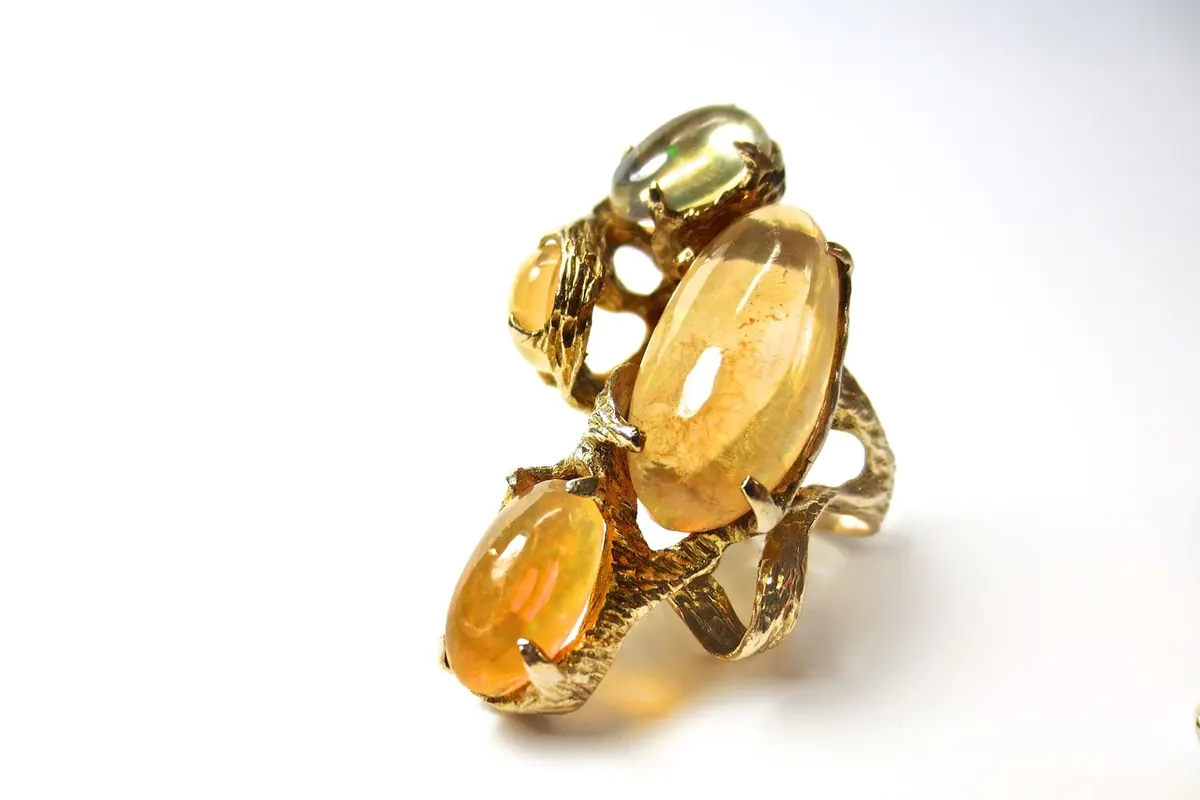
Two rings sit under the counter light. One throws green and copper flashes from a background so dark it looks like wet slate. The other glows with pastel pink and blue across a milky white stone. Both are opals, both are beautiful, and either could be the right ring for you — but they behave very differently on the hand, on the receipt, and in daily wear.
Here is what actually separates black opal from white opal, and how to work out which one belongs on your finger.
Black and white describe the background, not the colours
This trips up almost everyone buying their first opal. The words black and white refer to the stone's body tone — the overall darkness of the material sitting behind the play-of-colour — not to the colours flashing inside it. A black opal can show lime green, orange, electric blue, or all three at once. So can a white opal.
The trade grades body tone on a scale running from N1, almost jet, to N9, a pale milky white. Stones in the darker bands are sold as black opal; those at the light end are white or light opal. In between sit dark opals and crystal opals, the latter being semi-transparent, which gives a very different, almost glassy look.
Most black opal comes from Lightning Ridge in New South Wales. Most white opal comes from the Coober Pedy and Andamooka fields in South Australia. Origin matters less than the stone in front of you, but it explains a great deal about price.
How each one looks on the hand
Black opal is about contrast. Because the background is dark, the colours appear to float on the surface, and they stay readable in low light — candlelight, restaurant lighting, a grey winter afternoon. A 6mm black opal with a bright pattern often looks more commanding than a white opal of the same size, simply because your eye is drawn to the fire rather than the field around it.
White opal is about glow. The colours are softer and more diffuse, and the stone reads as bright and airy rather than dramatic. In strong direct sunlight, pale opals can look slightly washed out; they tend to be at their best in shade or indoors. If you want a ring that looks fresh and delicate, white opal delivers that. If you want something that stops a conversation mid-sentence, black opal usually wins.
What drives the price gap
Black opal is scarcer, and the very good examples are rarer still. The colours need to be bright and the pattern needs to be distinct against that dark background, and only a small proportion of what comes out of the ground manages both. A solid black opal with strong, even fire can cost several times what a white opal of identical size and brightness would.
That said, body tone is only one factor. Value comes from the combination of brightness, pattern, body tone, size and cut. A superb white opal with a rolling harlequin pattern will comfortably outprice a dull black opal with a muddy background. Buy the stone, not the label.
One thing worth checking: some stones sold as black opal are doublets or triplets — a thin slice of opal glued to a dark backing, sometimes with a clear quartz cap on top. These are perfectly legitimate, much more affordable, and more resistant to knocks, but they are not solid opal. Ask directly, and make sure the invoice says which you are buying.
Durability: closer than you might expect
Both are the same mineral — hydrated silica, carrying a few per cent water — and both sit around 5.5 to 6.5 on the Mohs hardness scale. Neither will shrug off the knocks that a sapphire or diamond would. A black opal is not tougher than a white one; the difference is appearance, not resilience. What protects an opal is the setting and your habits.
- Choose a bezel or rub-over setting for a ring you intend to wear often. It covers the vulnerable edges of the stone. Claw settings show more opal but leave the girdle exposed.
- Take it off for gardening, gym sessions, DIY, and anything involving heavy lifting. Opal chips rather than bends.
- Keep it away from chemicals — bleach, acetone, hair dye, dishwasher tablets — and never put it in an ultrasonic or steam cleaner.
- Avoid sudden temperature changes. A hot bath to a cold windowsill is the kind of shock that can start fine surface cracks, known as crazing.
- Store it in a soft pouch, never loose in a box with harder stones. Clean with a soft damp cloth and dry it properly afterwards.
Well-cut Australian opal is generally stable, and a ring worn sensibly will last decades.
Settings and styling
Metal choice changes how an opal reads more than most people expect.
- Yellow or rose gold warms a white opal and gives it a vintage, almost heirloom feel.
- White gold, platinum or silver frames a black opal and pushes its contrast further.
- Black opal suits bolder, more architectural designs: wide bands, signet shapes, a single stone with clean lines.
- White opal suits delicate work: milgrain edges, slim shoulders, a small halo, clusters with diamonds.
- Skin tone is not a rule. Try both against your hand in daylight. Some people find pale opal blends where they want a focal point; others find dark opal too heavy for everyday.
Which should you choose?
If you want a statement ring, wear it mostly for evenings and occasions, and have room in the budget, black opal is the more striking choice. If it is your first opal, you want something you can wear with jeans as easily as with a dress, or you are working to a tighter budget, white opal is the sensible starting point — and a good white opal is a genuinely beautiful stone.
Crystal opal is worth a look as a middle path. It sits between the two in tone, often shows unusually bright fire, and can be surprisingly good value if you like a translucent, watery look.
Before you commit
Look at both stones in daylight and then indoors. Opals that sing under shop spotlights can fall flat by a window, and the reverse happens too. Hold each ring against your hand rather than your finger alone, check the stone with a loupe for existing chips or hairlines, and ask what the stone is: solid, doublet or triplet. Confirm the returns policy before you pay, since opal looks different in every light.
For anything of real value, ask your insurer about listing the ring separately on your policy before you buy it, and get a written description or valuation from the seller. Cover for jewellery varies a lot between providers.
Finally, buy the one you keep looking back at. Opal is a stone people fall for, and the ring you reach for every morning is worth more than the one that merely ticks the right boxes.
Photo: AlexanderStein / Pixabay